
Agricultural Moisture Update March 2026
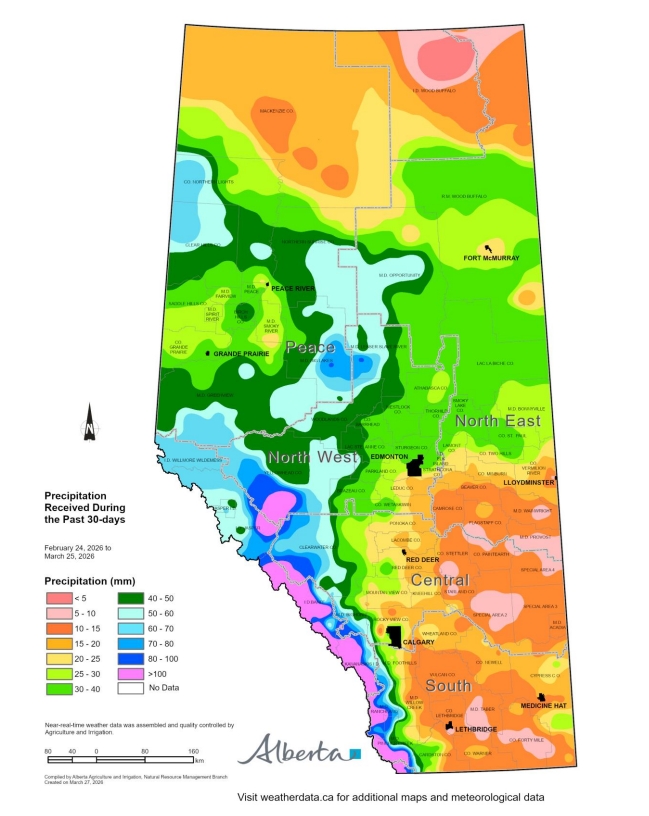
Over the past 30 days, agricultural regions across the province have received between 5 and 50 mm of precipitation.
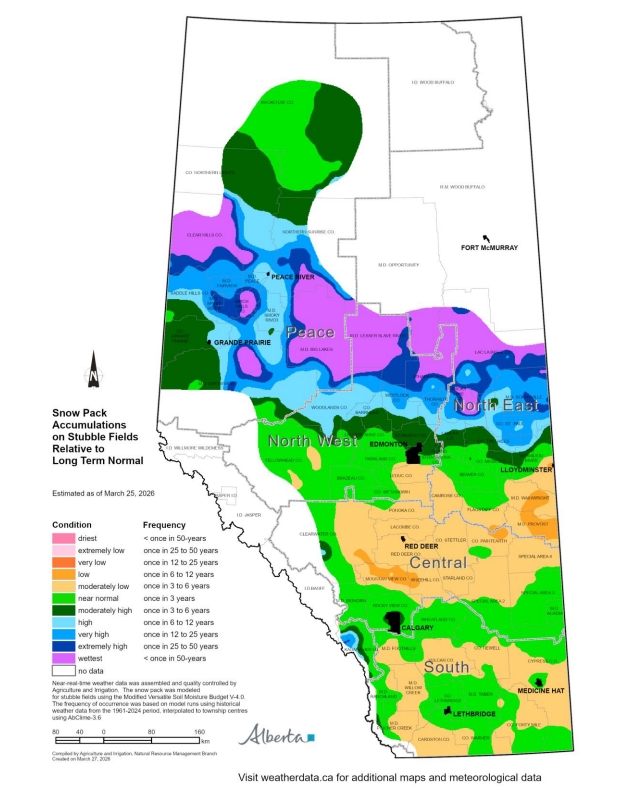
Pronounced temperature swings have contributed to substantial snowpack melt across the province. Several areas have experienced periods of snow accumulation followed by rapid melt. In many locations, surface soils have thawed during warm periods when snow cover was absent.
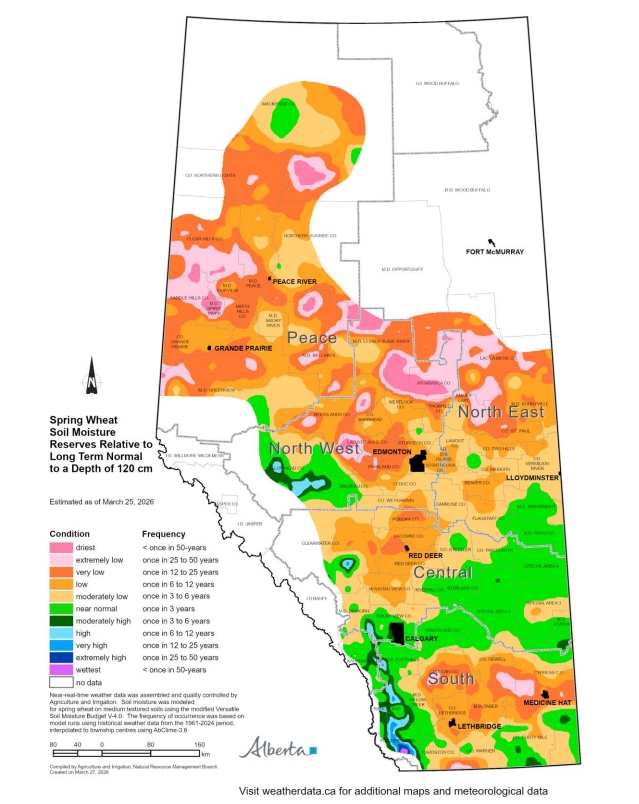
Soil moisture reserves have changed slightly in the Central and South Regions since the previous report, while conditions in the No Peace Regions remain largely unchanged. Across most of Alberta, soil moisture estimates remain moderately to very low compared with long term normals.
In parts of the South, North West, North East, and Peace Regions, soil moisture reserves are estimated to be extremely low. In these areas, moisture levels at the 120 cm depth are approximately 25 mm to 75 mm below normal.
Warm and windy conditions this winter have likely increased moisture losses through evaporation and sublimation. Recent warm weather has also driven rapid snowmelt across much of Alberta, which may help recharge dugouts.
Winter (November to March) is typically a dry period in Alberta, and even above average precipitation during these months rarely offsets year to date moisture deficits. The Peace Region receives at least 25% of its annual total during this time. For agriculture, May, June, and July remain the most critical months for moisture, providing at least 40% across much of the Peace Region.
Subscribe
Back to News Search
Contact Us
Saddle Hills
Junction of Hwy 49 & Secondary Hwy 725
RR1, Spirit River AB
T0H 3G0
T. 780-864-3760
Fax 780-864-3904
Toll-free 1-888-864-3760
frontdesk@saddlehills.ab.ca
Sign up to our Newsletter
Stay up to date on the Saddle Hills activities, events, programs and operations by subscribing to our eNewsletters.